Posts

LAD #39: Brown V. Board of Education

Image
In 1954 a court case lead to the declaration that segregation of children in public schools was unconstitutional. The Supreme Court ruled, in 1896, in the Plessy V. Ferguson , that public places could be legally segregated as long as they were equal, coining the phrase "separate but equal". However, in Brown V. Board of Education , Oliver Brown filed a suit against the Topeka, Kansas Board of Education. Linda Brown, Oliver Brown's daughter, was rejected from an all-white elementary school. Brown argued that the facilities of education were not equal, going against the Fourteenth Amendment. United States district court in Kansas upheld "separate but equal". The justice Earl Warren determined that "separate but equal" does not not belong in education. This decision affected the Little Rock Nine when the Nation Guard was brought to  ensure nine black students could attend school. 

LAD #38: Truman Doctrine

Image
Following World War II, America became troubled with the spread of communism. trying to "contain" communism, aptly called the policy of containment, Truman spoke with Congress in the Truman Doctrine. He advised that the United States aid Greece, which had been destroyed and was suffering political and economic instability after the war. Knowing this, Truman urged for political and financial installments for Greece to restore their nation. Also, Greece was at risk because of communist activities, so Truman was concerned since this made them vulnerable and threatened the nation. Truman also recognized that Turkey was unstable as well and required attention and work in order to preserve the order in the Middle East. Truman requested Congress' permission to loan Greece and Turkey a specific amount of money and be able to send American civilian and military personnel. All of these efforts caused the start of attempts to prevent the rise of totalitarian regimes in these count...

LAD #37: FDR's Executive Order 9066

Image
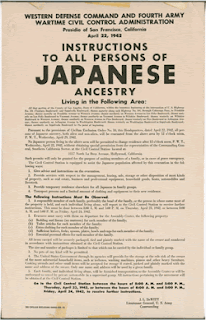
Taking measured to ensure national security, President Roosevelt issued Executive Order No.9066. This order essentially allowed the creation of military areas which were then used to relocate Japanese Americanas. The President ordered the Secretary of War and Military Commanders to create military areas where people would be excluded and allowed them to impose their own restrictions. This permitted the Secretary of War and Military Commanders to take adequate measured by providing support. This is seen in "Home is a Horse Stall" when Sox goes to the internment camp, which was a military area created by the government. I understand the need for national security of the time, however I believe that excluding Japanese Americans was a step too far, especially since these people were United States citizens.  This is similar to the Dawes Act which permitted the division and reorganization of the Indian  tribal land, forcing them onto reservations like the internment camps....

LAD #36: FDR's Declaration of War

Image
On December 8, 1941, the United States declared war on Japan. The Japanese attack on Pearl Harbor led America to declare war. FDR states that December 7, 1941, the day which Japan attacked Pearl Harbor, was "a date which will live in infamy". FDR goes on to explain how the United States had originally intended not to intervene in the warfare in these countries. However, the Japanese attack resulted in direct destruction of the United States, and American needs to defend itself. He explains how Japan has gotten out of control and have become hostile. Therefore, the United States has to fight them. Jeanette Rankin was the only member of the Houses that voted against the declaration war on Japan, this garnered her the nickname "Japanette Rankin" as she was looked down upon for her vote. This similar to when the United States entered the first world war since then, too, they had to abandon their policy of neutrality in favor of defending themselves. 

LAD/Blog #35: Home was a Horse Stall

Image
The story of how and wen Sox grew up broke my heart. Executive Order 9066 was put in place by Roosevelt to establish military areas and the Civilian Exclusion Order. No. 27 said that Japanese would be excluded from the West Coast. The first thing that caught my attention was when they were in the car and the radio announcement came on. Yumi expressed how terrible it was for her especially since she was not a US citizen, she's a first generation Japanese immigrant. Her native country was now the enemy and even her children recognized that their lives were going to change. This part portrayed how the children had become integrated into American life, but knew the fact that the US was against Japan would affect their lives. Secondly, the section where Sox sees the army style barracks and says she wants to stay there, however, she is told she cannot, is heartrending. She goes on to see that their new home is a horse stall and this illustrates how Americans did not treat these US citi...

LAD/Blog #34: FDR'S First Inaugural

Image
On March 4th, 1933, Franklin D. Roosevelt delivered his first inaugural address. He begins the speech by stating that the Nation is facing threatening conditions, but he will respond to these to allow the country to prosper. He asks for the support of the people as American has endured many dark times. Roosevelt tells the people not to paint, stating "the only ting we have to fear is fear itself".  He them goes on to talk about the issues in material and money that arise from banking. He continues detailing the problems of the United States, including the materialism of the Roaring 20's that led the money changers into the Stock Market Crash. Roosevelt understands that the public wants action. He suggest treating the issue like it was war, meaning mobilizing American and lowering unemployment. The President is going to have safeguards, regulation, and stop speculation. He then discusses his good neighbor policy which he plans to respect the rights and agreements of othe...

LAD/Blog #33: Kellogg-Briand Peace Pact

Image
The Kellogg-Briand Pact, or the Pact of Paris, was signed in 1928 as an agreement to outlaw war to prevent another conflict. The French Minister of Foreign Affairs, Aristide Briand, proposed the pact as an agreement between France and the United States to avoid war between them. However, President Coolidge and Frank B. Kellogg, the Secretary of State, were not completely supportive of the agreement and worried it would be considered an alliance which US would have to intervene if France was ever threatened. Therefore, they proposed that all nations be invited to outlaw war. The Pact agreed to outlaw war and use signatures to settle disputes in a peaceful manner. On August 27, 1928, fifteen countries signed the Kellogg-Briand Pact (France, the United States, the United Kingdom, Ireland, Canada, Australia, New Zealand, South Africa, India, Belgium, Poland, Czechoslovakia, Germany, Italy, and Japan). Eventually, other nations signed the pact as well. The Mukden Incident was the first te...

LAD/Blog #32: Willson's 14 Points of Peace

Image
Woodrow Wilson proposed his Fourteen Points on January 8, 1918. These points created a a basis for peace and were later incorporated into the Treaty of Versailles. However, these points, to a greater extent were idealistic. This is reflected in the failure of the Treaty of Versailles. Wilson's points were too lenient for some of the Allies. France, as an example, wanted to implicate harsh penalties and war reparations on Germany. Hence, the War Guilt Clause was created. Therefore, it is clear that the Fourteen Points were far too idealistic. Wilson could not implement the freedom of navigation, removal of economic barriers, and creating of new boundaries, amongst other points. He could not enforce the creation of the League of Nations, which the United States refused to enter. As seen in the lenient of the points and the reaction of the United States and other nations, Wilson's points were, to a greater extent, idealistic. The Fourteen Points set the foundation for the Tr...

LAD/Blog #31: Schenck V. United States

Image
In World War I, Schenck distributed circulars, which are letters addressed to a large group of people, with the purpose of getting the attention of those being drafted. He argued against the draft but only suggested peaceful action or resistance against the Conscription Act, an act that made wartime draft in the United States. However, Justice Holmes ruled that Schenck's actions violated the Espionage Act since his letters seemed to talk down the military and discourage people from attending. Holmes argued that Schenck's letters presented a "clear and present danger", so Congress had the right to stop and prevent those actions. This is similar to the Peter Zenger trail, since in the trial Zenger was tried for speaking out against the government, like Schenck. 

LAD/Blog #30: Wilson's First Inaugural

Image
Woodrow Wilson ran for president in 1912 and was elected as the democratic candidate. Wilson acknowledges the change in government- how it had become democratic. Wilson addresses certain aspects of the nation, including individuals, wealth, and the government. He then goes on to explain the "inexcusable waste" of the Gilded Age. Wilson looks to cleanse and reconsider. As a progressive president, he is clearly looking inward and hoping to make reform. Wilson emphasizes the need for laws to protect US citizens. He then ends by urging the people to dedicate themselves to the cause of reforming. This is similar to JFK's inaugural address which says the US can meet any hardships, similar to the hardships of reform during Wilson's time. 

LAD/Blog #29: Clayton Anti-Trust Act

Image
The Clayton Anti-Trust Act was passed in 1914 during Woodrow Wilson's presidency. The canadidates in the previous election all agreed that the government, especially the Supreme Court, had been too lenient with big businesses, so they believed the government needed to strengthen antitrust laws. The Clayton Anti-Trust Act of 1914 prohibited price discrimination and certain deal practices as well as expanded the power of private organizations to sue and obtain damages, allowed a labor exemption that permitted union organizing, and prohibited anticompetitive mergers. The Sherman Anti-Trust Act of 1890 was not enforced. The Federal Trade Commission and the Department of Justice are the two federal agencies who enforce antitrust laws. Both the Clayton Anti-Trust Act and the Sherman Anti-Trust Act regulated big business. 

LAD/Blog #28: Keating-Owen Child Labor Act

Image
The Keating-Owen Child Labor Act was an Act passed in 1916 prohibiting the shipment of goods or products between states if the product was worked on by a child in the past 30 days. Children younger than fourteen cannot work on these items and children between fourteen and sixteen cannot work more than eight hours in a day, six days a week, after seven, or before six. This act contributed to the progressive movement by regulating the conditions in which employees work. However, the Supreme Court declared this law unconstitutional on the grounds that child labor was not involved with interstate commerce therefore, the states must regulate it. Similarly, in John Spargo's The Bitter Cry of the Children, he advocated against child labor. 

LAD/Blog #27: MLK, Jr.'s "I have a dream" speech

Image
Martin Luther King Jr. was a well-known advocate of civil rights. His "I have a dream" speech clearly illustrate his support for integration between black and white communities. King references Lincoln and His emancipation proclamation saying that even after one hundred years of slaves being free, the black population is still suppressed by discrimination and segregation. He compares the struggle between the black community and a check. The check, in comparison to the Constitution, was meant to included both black and white citizens. Nonetheless, for blacks, the check was marked "insufficient funds". But, king does not believe "the bank of justice is bankrupt". He pushes for a fight against injustice but warns the people not to lose their dignity. This speech supports the Civil Rights Act of 1964, which ended segregation of public areas and discrimination in employment/education. Just like King's speech, the Montgomery Bus Boycott was also a part ...

LAD/Blog #26: William Jennings Bryan's "Cross of Gold" Speech

Image
On July 9th, 1896, William Jennings Bryan presented his "Cross of Gold" speech. This speech addressed the issue over free coinage of silver at a ratio of silver to gold 16 to 1. He lays the foundation with "an individual is but an atom, he is born, he acts, he dies; but principles are eternal; and this has been a contest of principle." Bryan is stating how running in an election has everything to do with being a humanitarian principles. He addresses how Democrats have proposed the issue of money, but ties and friendships are still disregarded. He voices his disapproval of the dominating businesses of the time , and, instead he states how they are all businessmen. Bryan also encourages that people fight "in defense of our homes, our families, and posterity." Bryan ends his speech by saying that if anyone tries to defend the gold standard, he will take issue with them because he believes people should not "crucify mankind on the cross of gold." ...

LAD/Blog #25: The Dawes Act

Image
The Dawes Act was enacted by Congress by 1887; it was an Act to provide lands to various Indians on allotted reservations. Therefore, the President can divide up common or tribal lands so an individual owns them. Some land was given to the head of each family, each single person over 18, every orphan over 18, and each single person under 18 that was born before the Dawes Act. This gives the President and government power, since they can reserve land and give it to American settlers when needed. Native American that were not on a reservation were given equal allotment. Also, the allotment holder is able to be a United States citizen. However, the civilized tribes were left out of this agreement.  The Homestead Act of 1862 is similar to the Dawes Act  in that it offered land to American settlers. 

LAD/Blog #24: Populist (People's) Party Platform

Image
In the Preamble, the Populist Party states how the people of America were demoralized and the public opinion has been suppressed. They promise to right two wrongs: the fact that the industries of America support only a few wealthy people or companies and that the currency is not adequate.  In the platform, they voice how the union forces of labor will be permanent, wealth belongs to the individual who brought it about, and that railroads should be regulated. They also stressed a need for a national currency. They demand increased coin circulation, a graduated income tax, and that the state and national income taxes be limited. They endorse public transportation and say that it is a public necessity, they also say that land is a heritage. In Expression of the Sentiments, they list resolutions including the free ballot, support for fair and liberal pensions for soldiers, limiting the president to one term, opposing national aid, shorter work days, and support of income tax. Don...

LAD/Blog #23 : McKinley's War Message

Image
William McKinley did not support the war, but he gave in to the people's calls. He then realized he would have to address the conflict and the concern of the people. H recognizes that rebellions in Cuba happened often and Cuba was trying to escape oppression. Even though they have attempted to avoid foreign involvement, trade was suffering, money was being lost and people were becoming angry. Peace attempts were made, but Spain remained in control. McKinley wants to physically exhaust the Spanish as a military victory seems impractical. The Spanish did not plan to give up Cuba. McKinley voiced how his views have changed with time and he now believes Unites States intervention is justified. He asks Congress for four reasons: it is America's duty to end inhumane treatment, America should protect those who can not protect themselves, offenses to commerce, trade, and industry were made, and the affairs in Cuba could risk peace in America. McKinley also discusses demolition of Mai...

LAD/Blog #22: Carnegie's Gospel of Wealth

Image
Andrew Carnegie's "Gospel of Wealth" reveals how the difference between the rich and the poor have benefitted civilization. Carnegie incorporates the idea of Social Darwinism, or survival of the fittest when he expresses that, "while the law may be sometimes hard for the individual, it is best for the race, because insures the survival of the fittest in every department." Therefore, Carnegie displays the imbalance in society which had been beneficial since the most prepared citizens are the people who advance.  he started that this gap between rich and poor should be embraced because it will ultimately benefit society. This idea, though, only gives wealth to a precious few. The laws are biased toward the wealth since the government has a lassie-faire approach. He offers possible solutions for dealing with excess wealth, for the good of society. These solutions are: leaving money for families, the public can use it, or the wealthy can give it out and use it as ...

LAD/Blog #21: Emancipation Proclamation

Image
The Battle of Antietam gave Lincoln the victory he needed in order to issue his Emancipation Proclamation. Lincoln's Emancipation Proclamation declared all slaves in the South free. He says that the slaves are welcome to join the Union's military and navy; that they will be recognized as free people and should abstain from violence. Similar to the Emancipation Proclamation, which declared an end to slavery, Brown v. Board of Education declared an end to slavery. 

LAD/Blog #20: Lincoln's 2nd Inaugural Address

Image
Lincoln begins his second inaugural address by saying there is no new information he can provide for them. the public already know the "progress of our arms", meaning the progression of the war. Lincoln explains that neither side wanted war, but one side wanted to split and one side wanted to stay unified, so there was no other choice. He then talks about how slavery was a catalyst for the war and, when war came, neither side anticipated how difficult it would be nor how large it would get. He discusses God and how Gods choices are "righteous and true altogether". To end his speech Lincoln to end the war and start rebuilding so the country may continue in peace. Woodrow Willson's Second Inaugural Address, like Lincolns, also stressed unity.